




Table of Contents
Shipping Surcharges From China: Fuel, Remote Area, Oversize, and Peak Fees
Time: Aug 26,2026 Author: SFC Source: www.sendfromchina.com
A China shipping quote can look pleasantly cheap at first. Then the final invoice arrives with a fuel adjustment, an extended-area fee, and a peak-season charge. Suddenly, the “cheap” parcel is not so cheap.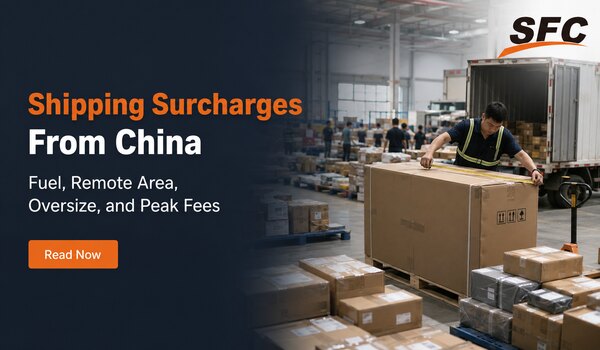
What will this shipment cost after the carrier, warehouse, route, package, and delivery conditions are all included?
- Condition: What shipment condition triggers the fee?
- Charge: How might the fee appear on a quote or invoice?
- Control: What can the seller do before dispatch or in the contract?
What Is a Shipping Surcharge?
The Main Fee Types
|
Fee Type
|
What It Usually Covers
|
Example
|
|
Base freight rate
|
Normal transportation from origin to destination
|
Standard parcel movement
|
|
Carrier surcharge
|
An extra carrier cost caused by fuel, size, location, demand, or handling
|
Fuel or remote-area surcharge
|
|
3PL pass-through charge
|
A carrier or third-party charge passed to the seller by the fulfillment provider
|
Carrier oversize fee plus agreed markup
|
|
Warehouse service fee
|
Work performed by the warehouse or 3PL
|
Relabeling, repacking, inspection, or special handling
|
|
Customs or brokerage fee
|
Clearance, documentation, disbursement, or inspection work
|
Brokerage charge on an express shipment
|
|
Duty and tax
|
Government charges connected to importation
|
Import duty or VAT
|
|
Customer-facing shipping fee
|
Amount charged to the buyer at checkout
|
Flat-rate or calculated shipping
|
A Simple All-In Shipping Formula
All-in shipping cost = base transportation rate + carrier surcharges + origin handling + destination handling + customs or brokerage charges where applicable + 3PL fees + expected exception cost
The Main Shipping Surcharges From China at a Glance
|
Surcharge
|
Typical Trigger
|
Where It May Appear
|
Seller Control
|
|
Fuel surcharge
|
Carrier fuel costs or a published fuel index
|
Carrier invoice or rate sheet
|
Partial; compare indexes and negotiate terms
|
|
Remote-area surcharge
|
Rural, island, mountain, or extended postcode
|
Shipping label or post-billing adjustment
|
Often; validate address and route
|
|
Residential surcharge
|
Delivery to a home rather than a business location
|
Parcel invoice
|
Partial; route by service and address type
|
|
Oversize surcharge
|
Length, girth, volume, or weight exceeds a threshold
|
Carrier invoice
|
Strong; right-size packaging
|
|
Additional handling
|
Irregular, fragile, unstable, or non-conveyable parcel
|
Carrier or 3PL invoice
|
Strong; improve packaging and labeling
|
|
Peak surcharge
|
Seasonal demand or network capacity pressure
|
Rate table or invoice
|
Partial; plan inventory and capacity
|
|
Demand or congestion fee
|
Temporary network, port, or capacity pressure
|
Freight or carrier invoice
|
Partial; adjust timing and route
|
|
Address correction
|
Incorrect, incomplete, or changed address
|
Carrier invoice
|
Strong; validate before label creation
|
|
Re-delivery or return fee
|
Failed delivery, refused parcel, or return to sender
|
Carrier and warehouse invoice
|
Strong; improve data and communication
|
|
Customs or brokerage fee
|
Clearance, inspection, or disbursement work
|
Carrier, broker, or 3PL invoice
|
Partial; improve documents and product data
|
Fuel Surcharges: Why the Base Rate Moves With Energy Costs

How Fuel Surcharges Work
Why Fuel Charges Are Hard to Compare
- Which fuel index is used?
- When does the adjustment update?
- Is the rate different for air, ground, ocean, or postal services?
- Is the adjustment applied to line haul, pickup, or other services?
- Are minimum fees or rounding rules involved?
- Does the quote show the current rate or a future estimate?
- Is the fuel fee already included in the headline price?
How to Control Fuel Exposure
- Compare all-in rates rather than base rates alone.
- Consolidate suitable parcels or supplier shipments.
- Avoid emergency transport caused by poor inventory planning.
- Ask for the fuel index, update schedule, and calculation base.
- Request a cap, floor, or notice period when shipment volume supports negotiation.
- Model several fuel scenarios in the margin calculation.
Remote Area and Extended-Area Surcharges

What Counts as a Remote Destination?
- low shipment density;
- islands and offshore locations;
- mountain or desert routes;
- distant rural postcodes;
- special ferry or feeder transport;
- limited delivery days;
- additional local handoff requirements;
- territories outside the carrier’s standard network.
Why a Remote Fee Appears After the Quote
- the provider used an outdated remote-area list;
- the order was routed through a different last-mile network;
- the address required an additional delivery attempt;
- the quote excluded destination accessorial charges;
- the customer entered an incomplete or unusual address.
How to Reduce Remote-Area Cost
- Validate the postcode before promising a shipping price.
- Keep a current serviceability list for your main carriers.
- Compare postal, courier, pickup-point, and local delivery options.
- State remote-area exclusions in customer-facing shipping rules.
- Use destination-country inventory when remote demand is stable and concentrated enough to justify it.
- Add a remote-area reserve to the margin model instead of hoping the fee never appears.
Oversize, Large-Parcel, and Additional-Handling Fees

Actual Weight Versus Dimensional Weight
Dimensional weight = length × width × height ÷ carrier divisor
Common Oversize and Additional-Handling Triggers
- maximum length;
- length plus girth;
- total volume;
- actual weight;
- irregular or cylindrical shapes;
- non-conveyable parcels;
- unstable or poorly wrapped pallets;
- exposed edges or loose straps;
- packages that require manual sorting;
- products that need special protection or labels.
Packaging Materials and Oversize Prevention
- corrugated cartons for stackable products;
- poly mailers for suitable soft goods;
- padded mailers for products that need light impact protection;
- inserts and void fill to stop movement;
- pallets and stretch wrap for stable freight units;
- clear labels placed where scanners can read them;
- export-ready packaging that does not need another repack at origin.
A Simple Oversize-Control Test
- product dimensions;
- current package dimensions;
- actual weight;
- billed weight;
- packing time;
- damage and return rate;
- any additional-handling or oversize fee.
Peak, Demand, and Capacity Surcharges

Peak Season Is a Capacity Problem
- major shopping events;
- holiday parcel volume;
- product launches and crowdfunding campaigns;
- weather disruption;
- factory shutdown planning;
- limited flights or vessel space;
- labor shortages;
- port, airport, or line-haul congestion.
How to Plan for Peak Charges
- Forecast units, parcels, dimensions, destinations, and service mix—not units alone.
- Secure capacity early for products with hard customer promises.
- Pre-build bundles and packaging materials.
- Ship replenishment stock before the busiest window when storage economics support it.
- Set clear order cutoffs and communicate realistic delivery dates.
- Compare the cost of a premium service with the cost of late delivery, refund requests, and lost repeat orders.
- Confirm the peak-fee effective dates and exceptions in writing.
|
Fee Situation
|
Typical Trigger
|
Planning Window
|
Preventability
|
Useful KPI
|
|
Published peak surcharge
|
Carrier-defined busy period
|
Several weeks or months
|
Partial
|
Cost per shipped parcel
|
|
Demand surcharge
|
Sudden volume or network pressure
|
Shorter and less predictable
|
Partial
|
On-time delivery by service
|
|
Congestion-related charge
|
Port, airport, or line-haul delay
|
Route dependent
|
Partial
|
Transit-time variance
|
|
Emergency capacity charge
|
Limited space or disrupted route
|
Immediate
|
Low to partial
|
Successful delivery rate
|
Other Surcharges Sellers Commonly Miss

Residential Delivery Fees
Address Correction and Invalid Address Fees
- missing apartment or unit numbers;
- wrong postal codes;
- city and postcode mismatch;
- incomplete phone information;
- transliteration differences;
- abbreviations that confuse the local delivery system.
Re-Delivery, Return-to-Sender, and Failed-Attempt Charges
Customs, Brokerage, Disbursement, and Inspection Charges
- Duty and tax are government charges.
- Brokerage covers customs-entry work.
- Disbursement may cover a provider advancing money or managing payment.
- Inspection may create extra examination or handling work.
- Clearance service fees may be charged by a carrier, broker, or 3PL.
Special Handling and Restricted-Item Fees
Can Multiple Surcharges Apply to One Shipment?
|
Charge
|
Illustrative Amount
|
Possible Trigger
|
Controllability
|
|
Base transportation
|
$18.00
|
Standard route and service
|
Compare providers
|
|
Fuel adjustment
|
$2.16
|
Published adjustment applied to base transport
|
Partial
|
|
Residential delivery
|
$3.50
|
Home delivery classification
|
Partial
|
|
Remote-area fee
|
$7.00
|
Destination postcode on carrier list
|
Partial
|
|
Peak fee
|
$2.50
|
Effective date during a busy period
|
Partial
|
|
Address correction
|
$5.00
|
Missing or incorrect address detail
|
Strong
|
|
Illustrative total
|
$38.16
|
Several conditions stack
|
Audit each trigger
|
How to Audit a China Shipping Invoice
Step 1: Match the Invoice to the Shipment Record
Step 2: Recalculate Billable Weight
Step 3: Verify the Trigger
Step 4: Separate Pass-Through Fees From Markup
Step 5: Compare the All-In Result
|
Audit Check
|
Evidence Needed
|
Question
|
|
Fuel
|
Effective table and calculation base
|
Was the right index and date used?
|
|
Remote area
|
Postcode list and destination
|
Was the fee valid for this service?
|
|
Oversize
|
Measured dimensions and weight
|
Was billable weight calculated correctly?
|
|
Peak
|
Published effective period
|
Did the shipment fall inside the period?
|
|
Address correction
|
Original and corrected address
|
Was the error preventable?
|
|
Customs or brokerage
|
Entry, broker, and payment records
|
Is this a shipping surcharge or a clearance fee?
|
|
3PL handling
|
Work order and contract definition
|
Was the extra warehouse work authorized?
|
How to Reduce Avoidable Shipping Surcharges
1. Improve Shipment Data
2. Improve Packaging
3. Improve Consolidation
4. Improve Routing
5. Improve Contracts
How to Compare Shipping Quotes From China
|
Quote Field
|
Question to Ask
|
Why It Matters
|
|
Base rate
|
What transportation does this include?
|
A low base may exclude many accessorials
|
|
Fuel
|
What index, date, base, and update cycle apply?
|
Fuel rates can move independently
|
|
Remote area
|
Which postcode list is used?
|
Country-only pricing is often incomplete
|
|
Oversize
|
What divisor and thresholds apply?
|
Package dimensions can change the bill
|
|
Peak
|
What dates and services are covered?
|
Seasonal costs may be time limited
|
|
Handling
|
Are batteries, liquids, or irregular items excluded?
|
Product attributes can change routing
|
|
Customs
|
Are brokerage, disbursement, duty, and tax included?
|
DDP and DAP treatment differs
|
|
Currency
|
Which currency and exchange basis apply?
|
Conversion can change the comparison
|
|
Validity
|
How long is the quote valid?
|
A rate can expire before dispatch
|
|
Returns
|
What happens after failed delivery?
|
The first shipment is not always the final cost
|
|
Tracking
|
What scan events and delivery evidence are provided?
|
Cheap tracking can create support work
|
What to Put in a 3PL or Carrier Agreement
- each fee name and trigger;
- effective dates and notice periods;
- the data source for fuel and peak adjustments;
- ownership and update timing of postcode lists;
- measurement and re-weigh dispute procedures;
- pass-through charge versus provider markup;
- service-level, cutoff, and handoff definitions;
- chargeback, credit, and claim procedures;
- invoice evidence requirements;
- peak-capacity commitments;
- product, route, and destination exclusions.
A 30-Day Surcharge-Control Plan
Week 1: Collect and Classify
Week 2: Find the Largest Avoidable Triggers
Week 3: Test Operational Changes
Week 4: Update Pricing and Contracts
When a China-Based Fulfillment Model Helps
Conclusion
FAQs
1. What is a shipping surcharge from China
2. Why is there a fuel surcharge on my China shipping invoice?
3. How is a remote-area surcharge calculated?
4. What causes an oversize shipping surcharge?
5. Can fuel, remote-area, oversize, and peak fees be charged together?
6. Are shipping surcharges negotiable with a China 3PL?
7. How can I avoid remote-area delivery fees?
8. How can packaging reduce oversize and dimensional-weight charges?
9. Are customs duties and taxes the same as shipping surcharges?
10. How should I compare shipping quotes from China?
 Post Views:256
 TAGS:
Ecommerce Marketing
TAGS:
Ecommerce Marketing
Copyright statement: The copyright of this article belongs to the original author. Please indicate the source for reprinting.
Previous Post
China Fulfillment RFP Template: 35 Questions to Compare 3PL Quotes
Next Post
How to Reduce Fulfillment Cost Without Slowing Down Delivery
TAGS
Hot Research
Get a Custom China Fulfillment Solution with FREE Storage for 30 Days
Want to know about our services, fees or receive a custom quote?
 Want to know about our services, fees or receive a custom quote?
Please fill out the form on the right and we will get back to you within a business day.
The more information you provide, the better our initial response will be.