




Table of Contents
Get Custom eCommerce Fulfillment Service
Book a Meeting
What Does In Transit Mean: All You Need To Know
Time: Jun 26,2023 Author: SFC Source: www.sendfromchina.com
Updated: September 1, 2026

You place an order, receive a tracking number, and see two vague words: In Transit.
It usually means the parcel has entered the delivery network and is heading toward its destination. It may be on a truck, plane, train, or ship. It may also be sitting at a sorting hub, waiting for a connection, clearing customs, or waiting for the next scan.
So, no, this status is not a live GPS dot. Think of tracking as stamps in a passport. Each scan confirms a milestone, but it does not show every minute between milestones.
What Does In Transit Mean?

So, what does 'In Transit' signify in shipping and logistics? It essentially implies that your parcel has been dispatched from its origin (warehouse, distribution center) and is presently on its way to the designated destination (the customer's home address). This status indicates that your package is actively moving through the courier's delivery network, getting closer to its final delivery point.
When your package is marked as "in transit," it's on its journey towards its final destination. This involves transportation, be it by air, ground, or sea, from one location to another - typically, from the warehouse where it was stored and packed to a local distribution center.
In shipping, in transit means a package has left its starting point and is somewhere within the transportation or delivery process. It has not yet been recorded as delivered.
The parcel could be:
- Moving between sorting facilities
- Waiting inside a carrier hub
- Loaded in a truck, aircraft, rail container, or vessel
- Awaiting customs processing or a carrier handoff
- Moving toward the local last-mile depot
The important bit is this: “in transit” describes the package’s stage in the journey. It does not guarantee physical movement at that exact moment.
Does In Transit Mean the Package Is Moving Right Now?
Not necessarily. A parcel may rest overnight at a distribution center or wait in a sealed trailer until the load is processed. During an international handoff, one carrier may release it before the next operator scans it.
It is like changing trains. Your journey is still underway while you stand on the platform. The parcel works much the same way, only with less coffee.
In Transit vs Out for Delivery and Other Tracking Statuses
| Tracking status | What it normally means | Likely next event |
| Label created / pre-shipment | A tracking number exists, but physical handoff may not have happened | Carrier acceptance |
| Shipped / accepted | A carrier or shipping partner has received the parcel | Sorting or departure |
| In transit / on the way | The parcel is moving through the network or waiting at a node | Another facility, customs, or local depot |
| Customs clearance | Customs data, duties, or inspection is being processed | Release or information request |
| Out for delivery | The local facility has assigned the parcel to a delivery route | Delivery attempt |
| Exception / delayed | An event may change the route or delivery date | New estimate or required action |
| Delivered | The carrier recorded delivery | Recipient confirms receipt |
In Transit vs Shipped
“Shipped” may mean the seller dispatched the order, but some stores use it as soon as a label is generated. The first carrier-acceptance scan is stronger proof of handoff.
“In transit” normally appears after the network journey begins. Still, platforms may translate carrier events differently. Read the latest event, timestamp, and location—not only the large status label.
In Transit vs Out for Delivery
An in-transit parcel may still be several hubs away. An out-for-delivery parcel has usually reached the local facility and been dispatched to a driver or postal carrier.
Out for delivery normally means an attempt is planned that day. Weather, workload, access problems, or a missed scan can still push it to the next working day.
In Transit vs Delivery Exception
In transit is a normal stage. A delivery exception means an unexpected event has affected the shipment or estimated date. Causes include weather, address errors, customs paperwork, damage, and missed connections.
The Differences Between In Transit and Out for Delivery
As we mentioned above, if your package is marked as "in transit", it means that your parcel is shipped from the warehouse.
The status of your package is updated to 'Out for Delivery' when the courier company has placed it on the delivery vehicle. This indicates that your package is on the final leg of its journey, heading directly towards its delivery address.
The status of your package is updated to 'Out for Delivery' when the courier company has placed it on the delivery vehicle. This indicates that your package is on the final leg of its journey, heading directly towards its delivery address.
What is In Transit?
Your package is shipped from the warehouse and is on the way to the final leg of its journey.
What is Out for Delivery?
Out for Delivery stands for the package that left the final pickup point or local distribution center and is coming to your door or the destination.
What Does In Transit Mean In FedEx, USPS, and Shein?

What does in transit mean in FedEx
FedEx, short for Federal Express, is an American multinational delivery services company founded in 1971 by Frederick W. Smith. The company is known for its overnight shipping service, as well as pioneering a system that tracks packages and provides real-time updates on package location.
In Transit means FedEx has picked up your package and shipped it to its destination through various FedEx facilities and transport systems.
In Transit means FedEx has picked up your package and shipped it to its destination through various FedEx facilities and transport systems.
What does in transit mean in USPS
The United States Postal Service (USPS) is an independent agency of the executive branch of the United States federal government responsible for providing postal services in the United States, including its insular areas and associated states. It is one of the few government agencies explicitly authorized by the United States Constitution. USPS provides a variety of mail and shipping services, both domestically and internationally.
In Transit in USPS means that USPS has received your package and kick-started the shipping procedure.
You can monitor your package's journey via the USPS online tracking system, which offers updates on the arrival and departure times at each handling facility.
In Transit in USPS means that USPS has received your package and kick-started the shipping procedure.
You can monitor your package's journey via the USPS online tracking system, which offers updates on the arrival and departure times at each handling facility.
What does in transit mean in Shein
As a global online fashion retailer operating in China, Shein provides free standard shipping for any purchase over $49. You can also choose expedited shipping services by charging a nominal cost.
If your tracking status is in transit on Shein, it refers to your package is leaving Shein's warehouse and on its way to the destination. It may take a couple of days or a week according to the specific location you are in.
Where does Shein ship from?--Click here to know more about Shein's secret success.

If your tracking status is in transit on Shein, it refers to your package is leaving Shein's warehouse and on its way to the destination. It may take a couple of days or a week according to the specific location you are in.
Where does Shein ship from?--Click here to know more about Shein's secret success.
How Long Does In Transit Take?
There is no universal duration. The status does not start a standard countdown.
Timing depends on the service, distance, weekends, holidays, customs, remote-area delivery, available transport, peak volume, and carrier handoffs. Express shipments may complete the journey within several business days. Standard cross-border parcels may take one or more weeks, while economy postal routes can take longer.
Those are planning patterns, not promises. The carrier’s estimate and service rules matter more than the words “in transit.” Also remember that transit time excludes some warehouse processing before carrier pickup.
A Better Way to Judge Whether the Wait Is Normal
| What you see | What to do | Why |
| Recent scan and delivery date not passed | Wait and monitor | The network is reporting progress |
| No scan during a long-haul or international leg | Check origin and destination tracking | Not every leg creates a public parcel scan |
| Estimated date has passed | Contact the seller or carrier | The shipment may qualify for an inquiry |
| Customs, tax, or address request | Respond through an official channel | Movement may pause until action is taken |
| Repeated facilities or an exception | Ask the shipper to investigate | A routing, label, or handling problem may exist |
Avoid a universal “X days means lost” rule. A short scan gap may be unusual for a premium domestic service but normal during a postal handoff.
Why Is My Package Stuck In Transit?
Tracking may pause during long movement, batch processing, weekends, data synchronization, or a carrier handoff. Those are often normal. The latest detailed event helps separate a quiet journey from a real delay.
| Possible cause | What it may look like | Practical response |
| Weather or transport disruption | Revised estimate or no departure event | Monitor alerts and the new estimate |
| Hub congestion or missed connection | Several days at one facility | Ask the carrier or shipper to trace it |
| Customs issue | Document, tax, or inspection message | Confirm paperwork, value, duties, and importer details |
| Incorrect address | Address exception or return event | Contact the carrier promptly |
| Sorting error or misroute | Repeated facilities or wrong direction | Request an investigation |
| Damaged package or label | Processing exception or manual handling | Shipper may need to provide details or claim |
| Restricted goods | Security hold, rejection, or return | Check route and product rules |
| Possible loss | No event beyond the service’s inquiry window | Begin the official search process |
For international orders, diagnose packages stuck in customs before treating every silent scan as a transport failure.
International Packages: In Transit, Customs, and Carrier Handoffs
An international parcel may pass through an export facility, airline or line-haul partner, import gateway, customs, destination carrier, and last-mile depot. More handoffs create more legitimate gaps.
Does In Transit Mean It Cleared Customs?
No. Look for a specific event such as customs cleared, released by customs, or import clearance complete.
A clearance delay may require documents, duty payment, a corrected value, or a clearer product description. The commercial invoice, declared value, country of origin, description, and HS code should agree. Use the SFC HS code and tariff checker as a starting point, then confirm official destination rules.
Sellers with repeat problems can follow these steps for avoiding customs delays when shipping from China.
Why Tracking Numbers or Status Wording Can Change
The export provider and local courier may use different numbers or labels. Keep both references when available. If no local number appears, ask the seller or fulfillment provider whether a destination-carrier reference exists.
What Should You Do When Tracking Does Not Update?

For Buyers and Recipients
- Confirm the number and carrier. A copied digit can waste an afternoon. Been there.
- Read the detailed location, timestamp, and event message.
- Check the carrier’s own page and, for international mail, the destination post.
- Compare the latest scan with the estimated delivery date.
- Respond to official customs, tax, address, or delivery requests.
- Contact the seller when the delivery window passes. The sender may need to open the case.
- Use the carrier’s inquiry process once the service is eligible.
Avoid unexpected texts asking for a small “redelivery fee.” Open the carrier site yourself instead of tapping the message link.
For Ecommerce Sellers and Shippers
- Confirm picking, packing, labeling, handoff, and the first acceptance scan.
- Separate the latest physical event from a normalized status.
- Check the address, declared value, product description, HS code, and importer details.
- Review restrictions for batteries, liquids, aerosols, magnets, powders, and similar goods.
- Open the inquiry through the shipping account when required.
- Tell the customer what is known, what happens next, and when you will check again.
- Apply the store’s replacement, refund, and claim policy consistently.
Good ecommerce shipping solutions should provide route selection and usable tracking data, not just a cheap rate.
Labels, Packaging, and Tracking Standards That Prevent Gaps
Tracking begins with data, but the label must survive the trip. A perfect number is not useful when the barcode is folded over a box edge.
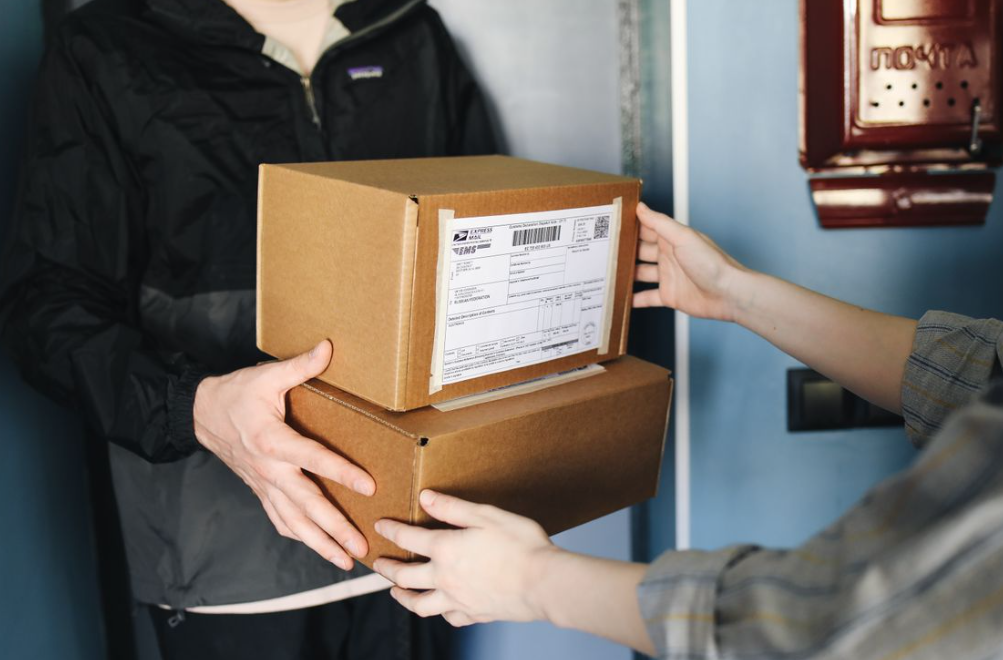
Shipping Materials That Affect Scanning
Use suitable thermal label stock and adhesive. Print a high-contrast barcode on a flat area away from corners and seams. Choose an outer carton or mailer that will not split, plus cushioning and sealing suited to the product. Cross-border shipments may also need an accessible document pouch.
Avoid wrinkled or reflective tape over the barcode. These small mistakes can send a parcel into manual processing. Compare ecommerce packing materials before applying one packaging rule to every SKU.
Relevant Tracking and Identification Standards
- UPU S10: A 13-character identifier for postal items, including a service indicator, serial number, check digit, and country code.
- GS1 SSCC: An 18-digit identifier for logistics units such as cases and pallets. The GS1 SSCC standard connects the physical unit with transport and receiving data.
- GS1 Logistic Label: Commonly carries the SSCC in scannable form.
- Carrier event codes and APIs: Seller systems map many detailed events into a smaller set of customer-facing statuses.
Poor status mapping can hide the difference between line haul, customs, and handoff. That is when one broad “in transit” label creates unnecessary support work.
Where In-Transit Visibility Matters Most
| Application or industry | Why visibility matters | Useful control |
| DTC and marketplaces | Unclear updates create “Where is my order?” contacts | Proactive milestones and realistic estimates |
| Fashion and beauty | High volume and returns can hide route problems | Carrier and destination reviews |
| Electronics and spare parts | Value, batteries, and downtime raise the cost of delay | Compliant routes, sturdy packing, early escalation |
| Cold-chain goods | Delay can affect temperature or shelf life | Specialized packing and contingency rules |
| B2B cartons and pallets | Appointments and receiving data matter beyond parcel scans | SSCC labels and consignee coordination |
| Returns and replacements | Two open journeys can confuse support teams | Separate references and return records |
How SFC Helps Sellers Reduce In-Transit Blind Spots
Sellers cannot control every carrier hub. They can control handoff quality, route choice, shipment data, and customer communication.
SFC’s China order fulfillment services connect receiving, order sync, picking, packing, labeling, international shipping, tracking updates, and returns. Stores can also use fulfillment API integrations to pass order and shipment data between sales channels and fulfillment operations.
Useful visibility answers simple questions: Was the parcel handed over? Which service was used? What was the last physical scan? Did the local carrier receive it? Is anyone waiting for documents or instructions?
That is how tracking becomes operational information instead of two words that make everyone refresh the page again.
FAQs About Packages In Transit
What does “in transit” mean for a package?
It means the package is between its origin and destination. It may be moving, sorting, waiting for a connection, clearing customs, or transferring carriers.
Does “in transit” mean the package is moving right now?
No. It may be inside a vehicle or waiting at a hub. Tracking records milestones rather than continuous location.
How long can a package stay in transit?
There is no universal limit. Check the service, route, latest physical scan, estimated delivery date, and carrier inquiry rules.
Why has my tracking not updated for several days?
The parcel may be between hubs, inside a sealed load, at customs, or between carriers. It may also be delayed. Check detailed events and the promised window.
What does “in transit to next facility” mean?
It means the package is expected to move toward another sorting or delivery facility. Depending on the carrier, the message may follow a scan or be system-generated.
What is the difference between in transit and out for delivery?
In transit covers the network journey. Out for delivery normally means the local facility assigned the parcel to a delivery route.
Can a package arrive today if it still says in transit?
It can if a scan or data feed is late. Still, in transit alone does not mean delivery is planned that day.
Does in transit mean an international package cleared customs?
No. Look for a customs-release or clearance-complete event. The parcel may still need inspection, payment, or documents.
When should I contact the seller or carrier?
Make contact when the estimated date passes, an exception requests action, or the service-specific inquiry window opens. The seller may have to start the case.
Can a damaged label, wrong address, or customs document cause a delay?
Yes. An unreadable barcode may require manual processing. Address errors can cause rerouting, while inaccurate customs data can stop a cross-border parcel.
 Post Views:38559
 TAGS:
SFC News
TAGS:
SFC News
Copyright statement: The copyright of this article belongs to the original author. Please indicate the source for reprinting.
Previous Post
How to Optimize Inventory Management: A Comprehensive Guide
Next Post
TAGS
Hot Research
Get Custom eCommerce Fulfillment Service
Book a Meeting
Get a Custom China Fulfillment Solution with FREE Storage for 30 Days
Want to know about our services, fees or receive a custom quote?
 Want to know about our services, fees or receive a custom quote?
Please fill out the form on the right and we will get back to you within a business day.
The more information you provide, the better our initial response will be.