




Table of Contents
Get Custom eCommerce Fulfillment Service
Book a Meeting
5 Kickstarter Scams That Fooled Thousands of Backers (and What They Teach)
Time: Oct 23,2026 Author: SFC Source: www.sendfromchina.com
Picture this. It's June 2013, and more than 3,000 people have pledged money for beef jerky. Not just any jerky, though. This is "Kobe beef" jerky, beer-fed, straight from Japan, with glowing reviews from taste tests at food festivals. The campaign asked for about $2,400. It pulled in over $120,000.
There was one small problem. The jerky didn't exist.
Kickstarter pulled the plug a few hours before the money was collected, so nobody lost a cent that time. Lucky. A lot of other backers weren't so lucky.
Look, crowdfunding is a great idea. You back someone with a cool idea, they make the thing, you get it first. Most of the time it works out fine. But "most of the time" isn't "every time", and when it goes wrong, it can go really wrong.
In this post we'll walk through five of the biggest Kickstarter scams and frauds: what was promised, what actually happened, which warning signs people missed, and what backers and creators can take away from it. We'll also be honest about something a lot of lists skip. Not every failed project is a scam.
What Counts as a Kickstarter Scam (and What's Just a Failed Project)
The word "scam" gets thrown around a lot. If you've waited three years for a gadget that never showed up, you'll probably call it a scam too. Fair enough, it feels like one. But there's a real difference between someone who lied to you and someone who tried, messed up, and ran out of money.
That difference matters. It decides whether the law gets involved, whether you have a shot at a refund, and, if you're a creator, how people will remember your name.
Kickstarter's own rule: deliver the reward or refund
First thing to know: Kickstarter isn't a store. The platform says it plainly in its help center, and it's worth reading Kickstarter's own refund policy once before you back anything.
Here's the short version. When a project gets funded, the money goes straight to the creator. The creator is then responsible for finishing the work, being honest with backers, and delivering rewards "to the best of their abilities". Kickstarter itself doesn't hand out refunds.
So the platform isn't really on the hook. The creator is. Keep that in mind, because it shapes everything else in this article.
Fraud, failure, or somewhere in between
Most Kickstarter disasters land in one of three buckets. Here's a simple way to tell them apart:
|
Type
|
What it looks like
|
Example
|
|---|---|---|
|
Deliberate deception
|
The product never existed, demos were faked, or backer money went to personal spending
|
Kobe Red, iBackPack
|
|
Execution failure
|
A real team made a real effort but couldn't build what they promised
|
ZANO (partly)
|
|
Money math gone wrong
|
Rewards were priced too low, and production and shipping costs ate the budget
|
Coolest Cooler
|
The Coolest Cooler is a good example of the third bucket. In 2014 it raised about $13.2 million from 62,642 backers for a cooler with a built-in blender, speaker and USB charger. At the time it was one of the most funded projects ever.
Then reality hit. Each cooler cost more to make and ship than many backers had paid. The company started selling coolers through retail to raise cash while backers were still waiting, which, yeah, didn't go down well. Oregon's Department of Justice stepped in with a settlement in 2017. By the end of 2019 the company had shut down, and roughly 20,000 backers never got their cooler.
Was that a disaster? Absolutely. Was it fraud in the legal sense? Not really. It's more of a warning about pricing and fulfillment, and we'll come back to that later.
How often do funded projects never deliver?
Less often than the horror stories suggest. In 2015, Wharton professor Ethan Mollick ran a study that Kickstarter commissioned (Kickstarter said it had no say in the results). He surveyed 47,188 backers across 30,323 projects.
The headline: about 9% of funded projects failed to deliver their rewards. Smaller projects failed more often. Among projects that raised under $1,000, around 13% never delivered.
So the big picture is that most projects do ship. Fraud is a slice of that 9%, not the whole thing. But when fraud does happen, it tends to be loud, and it tends to teach everyone something.
The 5 Biggest Kickstarter Frauds, Case by Case
"Biggest" here doesn't only mean the most money. Some of these cases changed how Kickstarter checks projects. Others were the first time a US regulator went after a crowdfunding creator. For each one we'll cover what was promised, what happened, what people missed, and the lesson.
1. Kobe Red: The Beef Jerky That Never Existed
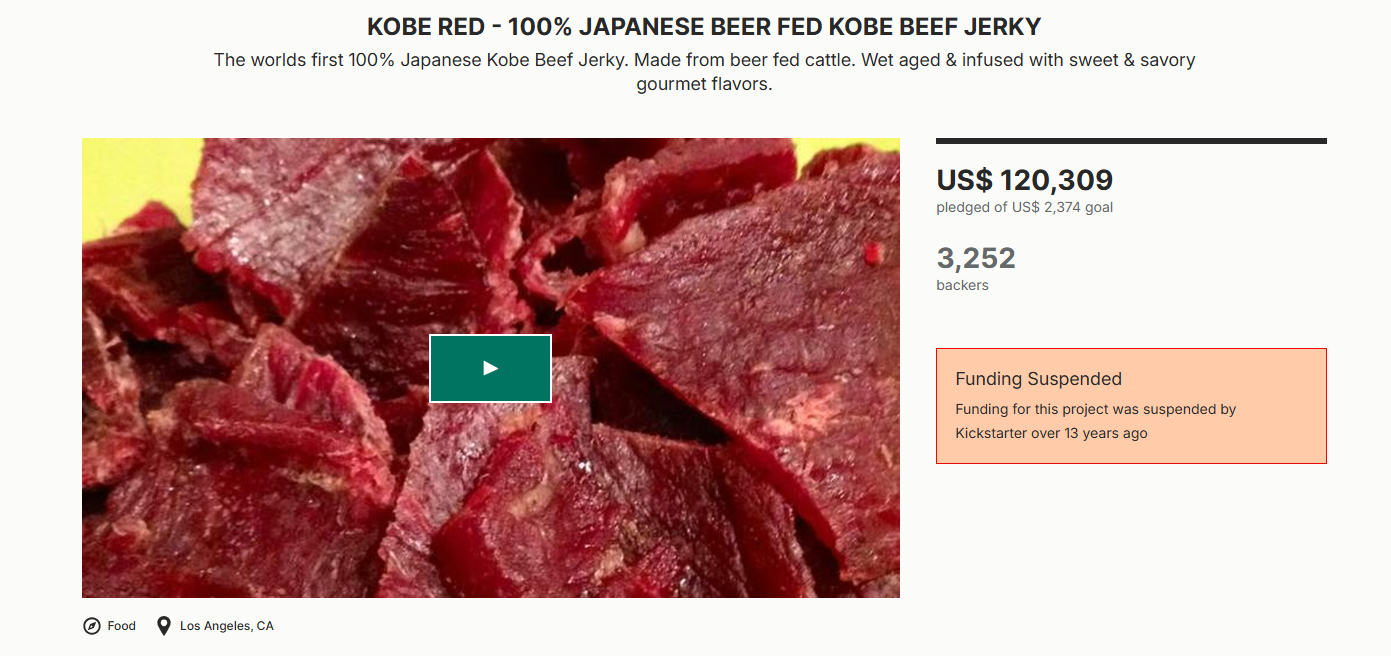
What was promised. Kobe Red promised jerky made from 100% Japanese beer-fed Kobe beef. The goal was tiny, around $2,374. Rewards came in tiers, from a few strips up to big bundles.
What happened. The campaign raised $120,309 from 3,252 backers. That's roughly 50 times the goal. For jerky.
A film crew working on a documentary called Kickstarted reached out to the team for an interview. The answers were vague. So the filmmakers kept digging. They found that the company behind it wasn't properly registered, and the taste-test reviews being shared online didn't hold up. Kickstarter suspended the project in June 2013, shortly before it was due to close. Because Kickstarter only collects money when a campaign ends, backers weren't charged.
What people missed. There were no real faces on the page. No team bios, no photos of the people behind it. The "reviews" came from events nobody could check. And the gap between a $2,374 goal and $120,000 in pledges should have made a few more people curious.
The lesson. Anonymous creator plus a wave of hype equals hit pause. Also, credit where it's due: this one was caught by the community, not by an algorithm. Asking awkward questions in the comments actually works.
2. The Doom That Came to Atlantic City: The FTC's First Crowdfunding Case
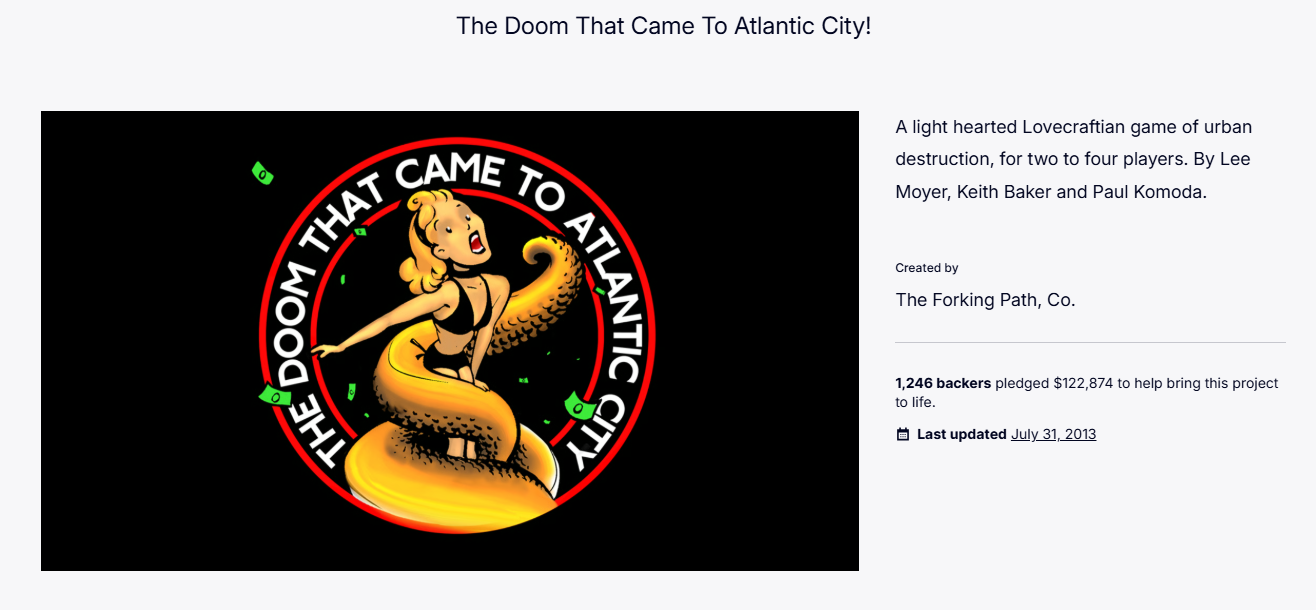
What was promised. A board game. Basically Monopoly, but with Lovecraft-style monsters destroying Atlantic City. Creator Erik Chevalier, through The Forking Path Company, set a goal of $35,000. Rewards included copies of the game and pewter figurines.
What happened. The campaign raised more than $122,000 from 1,246 backers. About 14 months later, Chevalier announced the project was cancelled and promised refunds.
The refunds never came. When the US Federal Trade Commission looked into it, it alleged the money had gone to things like rent, moving to Oregon, personal equipment, and licenses for a different project. Not exactly figurine production.
In June 2015 it became the FTC's first crowdfunding case. Under the settlement, Chevalier is barred from making deceptive claims in future crowdfunding campaigns and has to honor any refund policy he states. A judgment of $111,793.71 was imposed, then suspended because he couldn't pay. He didn't admit or deny the allegations.
There's a small happy ending, kind of. Another publisher, Cryptozoic Entertainment, later picked up the game and released it.
What people missed. Backers were told the game was moving along. According to the FTC, it wasn't, and no artists had been hired. Status updates that sound good but never show anything concrete, like factory photos, proofs or samples, are a pattern worth noticing.
The lesson. For backers: ask for proof of progress, not just words. For creators: failing is not illegal. Lying about progress and spending backer money on yourself is what turns a failure into fraud.
3. iBackPack: Backer Money Spent on Bitcoin and Credit Cards
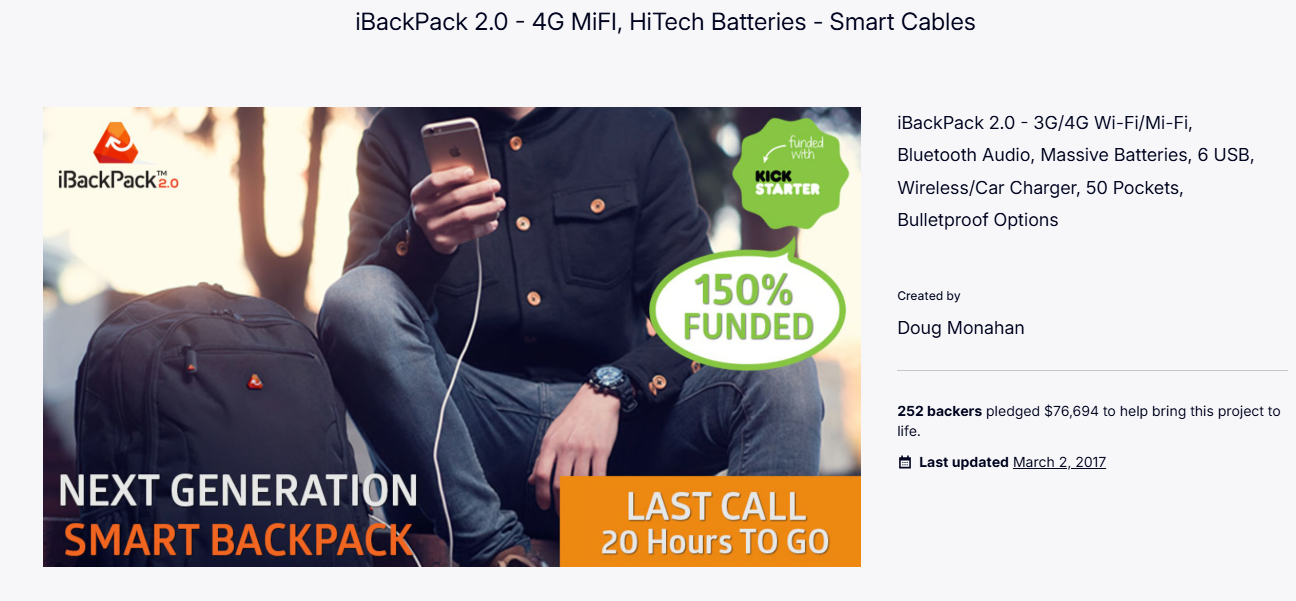
What was promised. A "smart" backpack loaded with charging gear and connected features, the kind of thing a tech-heavy commuter would love.
What happened. Douglas Monahan, through iBackPack of Texas, raised more than $800,000 across four crowdfunding campaigns on Kickstarter and Indiegogo. None of the promised products were delivered.
In May 2019 the FTC sued. It alleged Monahan used a big chunk of the money on personal stuff, including buying bitcoin, ATM withdrawals, and paying off personal credit cards. In 2020 he settled. He's now permanently banned from running crowdfunding campaigns, and a judgment of nearly $800,000 was suspended because he couldn't pay.
What people missed. New campaigns kept appearing before earlier backers had their bags. If a creator is raising money for version 2 while version 1 hasn't shipped, that's a red flag the size of a backpack. Products packed with batteries also bring real-world headaches. Lithium batteries come with special shipping rules, and creators who don't plan for that tend to hit walls.
The lesson. Check a creator's history before you pledge. Their past projects, and what those backers are saying in the comments, will tell you more than any slick video.
4. Skarp Laser Razor: No Working Prototype, Big Promises
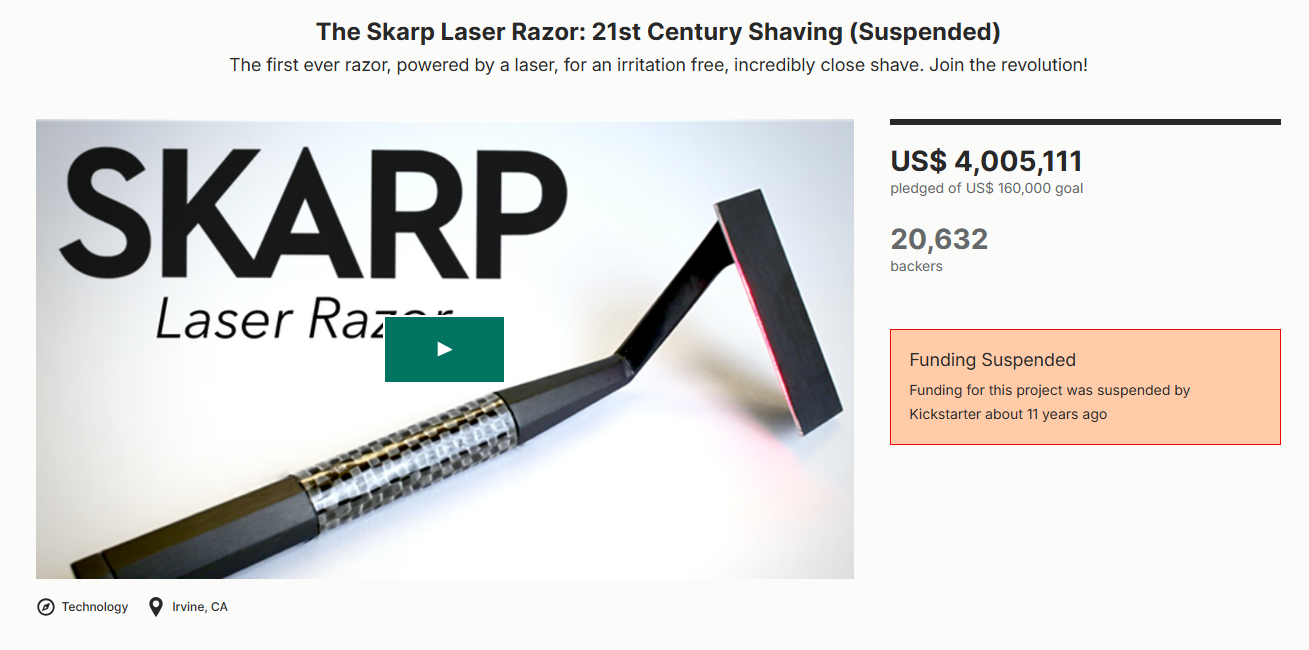
What was promised. A razor that shaves with a laser instead of a blade. No cuts, no irritation, sci-fi vibes. Who wouldn't want that?
What happened. In 2015 the campaign raised over $4 million from more than 20,000 backers. But the demo videos raised questions. Critics said they didn't clearly show the razor actually cutting hair the way the campaign claimed.
In October 2015, Kickstarter suspended the project. The reason it gave was a rule breach: physical products offered as rewards need a working prototype, and Kickstarter wasn't convinced Skarp had one. Backers weren't charged. Skarp soon moved over to Indiegogo and raised money there instead.
To be fair, nobody was found guilty of fraud here. But Kickstarter clearly decided the project broke its rules, and the $4 million pledged never changed hands.
What people missed. When a product sounds like it bends the laws of physics a bit, the demo needs to be extra solid. Short, edited clips aren't enough.
The lesson. Ask for an unedited, close-up demo. If a creator can't show the core feature working in one continuous shot, think twice.
5. ZANO: The Drone That Promised Too Much
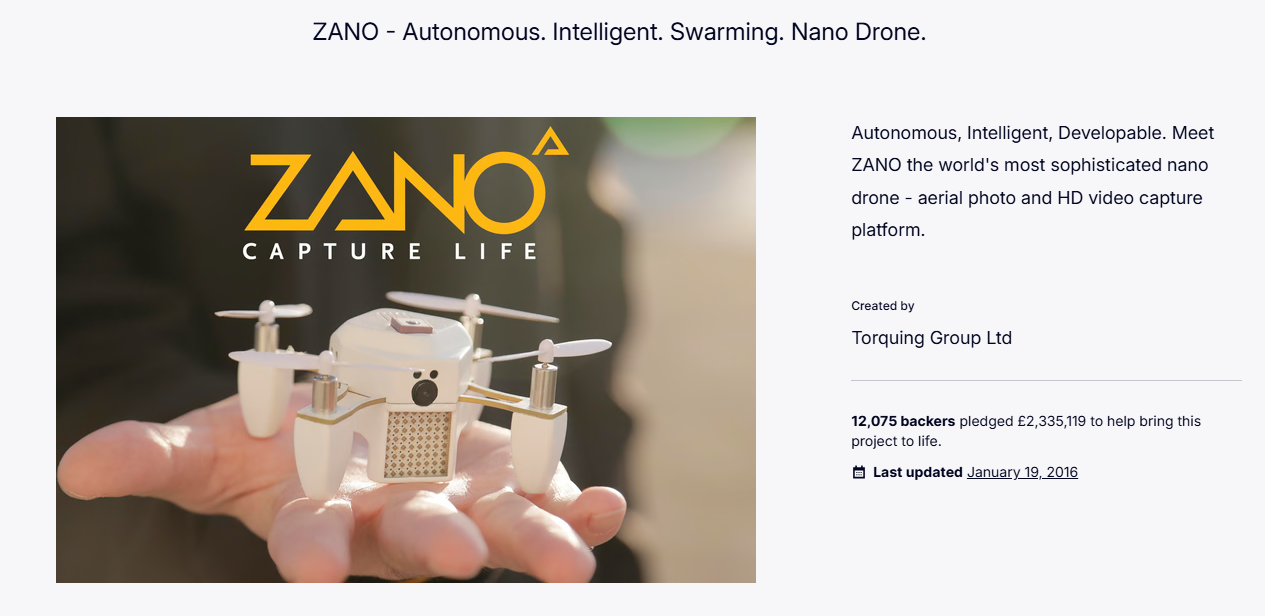
What was promised. A palm-sized drone that could fly on its own, follow you, and shoot HD video. The campaign called it an "autonomous, intelligent, swarming nano drone". That's a lot of buzzwords for something that fits in your hand.
What happened. UK company Torquing Group ran the campaign from November 2014 to January 2015. The goal was £125,000. It raised about £2.3 million from 12,075 backers, one of Europe's biggest Kickstarter campaigns at the time.
By November 2015 the CEO had resigned and the company went into liquidation. Only a small number of drones ever shipped, and very few reached Kickstarter backers.
Kickstarter then did something unusual. It hired investigative journalist Mark Harris to find out what went wrong. His report ran to more than 13,000 words. He concluded the team was serious and meant well, but didn't have the experience or resources to build what they'd promised. He also found convincing evidence that some of the demo footage had been faked.
What people missed. The specs were close to impossible for the size and price. And being 20 times overfunded doesn't make hardware easier. It just means 20 times more units to build, test and ship.
The lesson. Hardware is hard. Ask how the team plans to manufacture at scale, who their factory is, and how they'll get thousands of units to backers in different countries.
The 5 cases side by side
|
Case
|
Year
|
Raised
|
Backers
|
Outcome
|
Main warning sign
|
|---|---|---|---|---|---|
|
Kobe Red
|
2013
|
$120,309 (never collected)
|
3,252
|
Suspended by Kickstarter
|
Anonymous team, unverifiable reviews
|
|
The Doom That Came to Atlantic City
|
2012 to 2015
|
$122,000+
|
1,246
|
FTC settlement
|
Progress claims without proof
|
|
iBackPack
|
2019 to 2020 (FTC case)
|
$800,000+ across 4 campaigns
|
Not disclosed
|
FTC lawsuit and lifetime crowdfunding ban
|
New campaigns before old ones shipped
|
|
Skarp Laser Razor
|
2015
|
$4M+ (never collected)
|
20,000+
|
Suspended by Kickstarter
|
No convincing working prototype
|
|
ZANO
|
2014 to 2015
|
About £2.3M
|
12,075
|
Company liquidated
|
Demo footage that didn't hold up
|
Red Flags to Check Before You Back a Project
Okay, so how do you avoid being the person who pledged for imaginary jerky? You can't spot everything. But a few minutes of checking catches a lot.
Who's behind it?
Look for real names, real faces and a real history. A LinkedIn profile, a company website, past projects, interviews. If the team page is just a logo and a mission statement, that's not great. Anonymous creators aren't always scammers, but they have nothing to lose if things go sideways.
Real prototype or just a render?
Renders are pretty. Prototypes are proof. Kickstarter has long required working prototypes for physical rewards (that's exactly what sank Skarp), so look for footage of the actual product doing the actual thing. Bonus points if it's a bit rough around the edges. Honestly, an early prototype that looks too polished can be a warning sign in itself.
Price and timeline that sound too good
If a gadget that should cost $300 is offered at $59, with delivery in three months, ask yourself how. Making things, packing them and shipping them around the world all cost money. Somebody has to pay for that. If the math doesn't work on the campaign page, it won't work in the factory either.
No plan for manufacturing, shipping and duties
This is where a lot of honest projects fail. A good campaign will mention:
- Who's manufacturing the product, or at least where
- How rewards will be stored, packed and shipped
- Whether shipping and import duties are included in the pledge or charged later
- Which countries they can ship to, and which they can't
If shipping is a single line that says "TBD", be careful. That's not a plan, it's a hope.
Comments, updates and how the creator answers hard questions
Scroll through the comments. Are people asking tough questions? Are those questions getting real answers, or are they ignored, deleted or met with vague promises? Look at past updates too. A creator who posts photos from the factory, test results and honest delay notices is very different from one who goes quiet for months.
Here's a quick checklist you can run in five minutes:
|
Check
|
Good sign
|
Warning sign
|
|---|---|---|
|
Creator identity
|
Named team, history you can verify
|
No names, no photos, brand-new accounts
|
|
Prototype
|
Unedited video of the real thing working
|
Only renders or heavily edited clips
|
|
Pricing
|
Pledge price looks realistic for the product
|
Way cheaper than similar products
|
|
Fulfillment plan
|
Clear plan for production, shipping and duties
|
"Shipping TBD"
|
|
Communication
|
Regular, specific updates
|
Silence or vague promises
|
|
Track record
|
Past projects delivered
|
Repeated new campaigns, nothing shipped
|
What to Do If a Kickstarter Project Never Delivers
So you've pledged, and things are looking shaky. Or worse, you've already been waiting a year. What now?
Before the campaign ends: cancel your pledge
This is your easiest exit. While a campaign is still live, you can cancel your pledge yourself. Once the campaign ends and payment is collected, that option disappears. So if your gut says something's off during the campaign, listen to it. You can always back the creator's next project once they've proven themselves.
After it's funded: creator first, then Kickstarter, then regulators
Once the money is collected, refunds come from the creator, not from Kickstarter. So start there.
- Message the creator directly. Keep it polite and specific.
- Report the project to Kickstarter if you think the creator is being dishonest or has broken the rules. Kickstarter can't refund you, but it can investigate and act on the project.
- File a complaint with a regulator. In the US, that means the FTC or your state attorney general. Remember, both FTC cases in this article started because people complained.
What to put in a refund request
Make it easy for the creator to say yes. Include:
- The email address you used on Kickstarter
- The project name and the reward tier you backed
- The amount you paid and the date
- A short, clear reason, for example "the project was cancelled" or "no update in 12 months"
Keep copies of everything. Screenshots of updates, comments and messages can help later.
Card disputes and chargebacks: when they help
Some backers try disputing the charge with their bank or card issuer. Sometimes it works, sometimes it doesn't. Banks have time limits, and many treat a crowdfunding pledge differently from a normal purchase. It's worth asking your card issuer what their rules are. Just don't count on it as a guaranteed way out.
And one honest note. Even in the FTC cases above, most backers never got their full money back. The settlements banned bad behavior going forward, but the creators couldn't pay. Prevention beats recovery, every time.
Lessons for Creators: How to Not Look Like a Scam
If you're on the other side and planning a campaign, here's the uncomfortable truth. Backers have read the same horror stories you just did. They'll judge you with all five cases in the back of their mind. The good news is that most of what makes a scam look like a scam is easy to avoid if you're legit.
Budget the whole journey: production, freight, duties, packaging
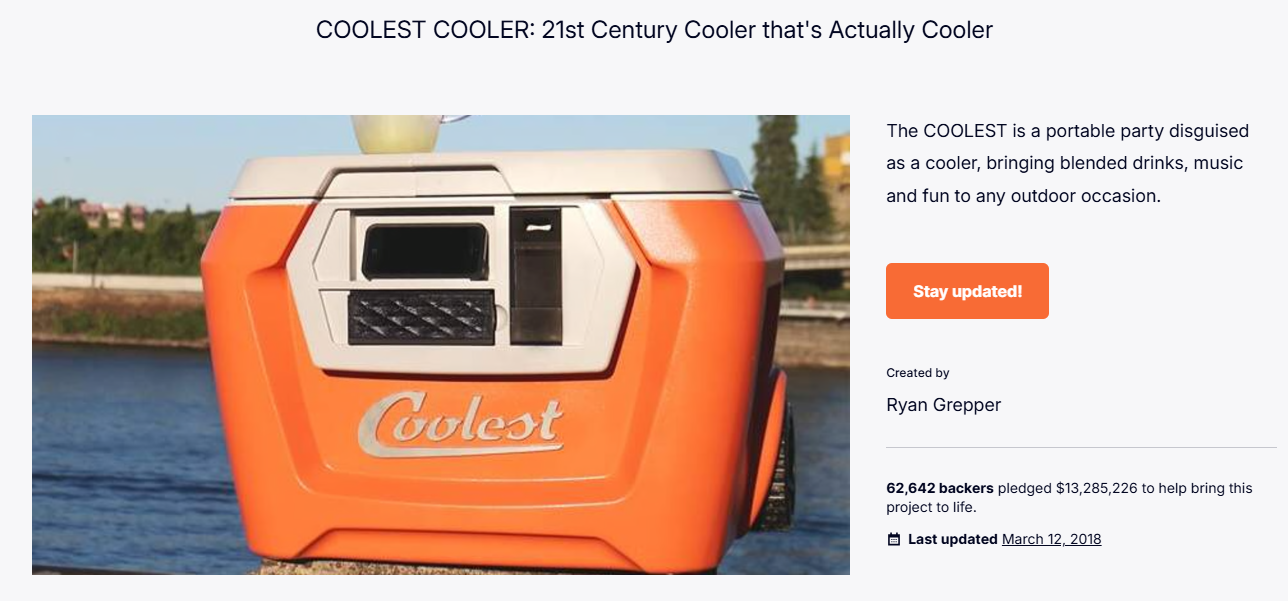
Coolest Cooler didn't fail because nobody wanted it. It failed because the numbers didn't add up. Before you set your pledge prices, work out the full cost of getting one reward into one backer's hands:
|
Cost item
|
What to think about
|
|---|---|
|
Manufacturing
|
Unit cost at your real order size, not your dream size
|
|
Freight to warehouse
|
Moving goods from the factory to where they'll be packed
|
|
Storage
|
How long rewards sit before they ship
|
|
Pick, pack and kitting
|
Packing different tiers, add-ons and stretch goals
|
|
Packaging materials
|
Boxes, inserts, protective packaging
|
|
International shipping
|
Varies a lot by destination, weight and size
|
|
Duties and taxes
|
Who pays, you or the backer, and in which countries
|
|
Buffer
|
Things will go wrong. Plan for it.
|
If you leave out even one of these, it can quietly eat your margin. Then you're in Coolest Cooler territory.
Plan reward fulfillment before launch
This is the part a lot of first-time creators leave too late. You've got thousands of backers, many reward tiers, add-ons and backers spread across dozens of countries. Somebody has to receive all that stock, check it, pack it tier by tier, and ship it out.
If your product is made in China, it often makes sense to handle fulfillment close to the factory. A Kickstarter fulfillment service can receive your finished goods, run quality checks, store them, pack each order by reward tier, and ship to backers in major overseas markets with tracking.
SendFromChina is a China-based crowdfunding fulfillment partner that does exactly this kind of work for campaigns on Kickstarter, Indiegogo and Gamefound. Board games are a common case, with lots of SKUs, expansions, deluxe editions and add-ons that need careful sorting. If that sounds like your project, have a look at our board game fulfillment service.
A tip from experience: talk to a fulfillment partner before your campaign goes live, not after. Shipping costs and duty rules for your key countries should shape your pledge prices, not surprise you six months later. Delivery times also depend on the route, the carrier, customs and the season, so plan with ranges and don't promise backers a fixed date you can't control.
Bad news early beats silence
Delays happen. Factories slip, parts run late, shipping gets stuck. Backers can usually live with that. What they can't stand is silence.
Post updates on a schedule, even when there's nothing exciting to say. Show photos from the factory floor. Share test results, the good ones and the bad ones. If something goes wrong, say so early and explain your plan. Creators who communicate this way rarely get called scammers, even when they're late.
Conclusion
Kickstarter scams are real, but they're not the norm. Most funded projects deliver, and plenty of the ones that don't are failures, not frauds. Still, the five cases here show the same patterns again and again: anonymous teams, demos that don't hold up, money that disappears, and creators who go quiet.
For backers, the fix is mostly homework. Check who's behind a project, look for a real prototype, read the comments, and cancel early if something smells off. For creators, it's about earning trust. Price your rewards honestly, plan production and fulfillment from day one, and talk to your backers like real people.
Crowdfunding works because people trust each other. Protect that, and everyone wins. Well, except the fake jerky guys.
If you're planning a campaign and want to sort out storage, packing and shipping before launch, you can get a free quote and see what your fulfillment costs might look like.
FAQs
What was the biggest Kickstarter scam ever?
It depends on how you measure it. By money pledged, the Skarp Laser Razor (over $4 million) and ZANO (about £2.3 million) are among the largest projects to collapse or get suspended. By legal impact, The Doom That Came to Atlantic City stands out because it was the FTC's first crowdfunding case.
How can you tell if a Kickstarter campaign is a scam?
Look for real people behind the project, a working prototype shown in unedited video, realistic pricing, a clear plan for production and shipping, and a creator who answers hard questions in the comments. If several of these are missing, be careful.
Can you get your money back if a Kickstarter project fails?
Sometimes. Kickstarter doesn't issue refunds itself. You need to ask the creator directly. If the creator refuses or disappears, you can report the project to Kickstarter, contact your card issuer, or complain to a regulator like the FTC.
Is Kickstarter responsible if a project doesn't deliver?
Not directly. Kickstarter's terms put the responsibility on the creator to complete the project and fulfill rewards. The platform can suspend projects that break its rules, but it doesn't refund backers.
What percentage of Kickstarter projects never deliver rewards?
A 2015 study by Wharton professor Ethan Mollick, commissioned by Kickstarter, found that about 9% of funded projects failed to deliver. Smaller projects, under $1,000, failed more often, at around 13%.
Has anyone been sued over a Kickstarter scam?
Yes. The FTC took action against Erik Chevalier over The Doom That Came to Atlantic City in 2015, and sued iBackPack's creator Douglas Monahan in 2019. Both cases ended in settlements that restrict their future crowdfunding.
What's the difference between a failed Kickstarter and a scam?
Intent and honesty. A failed project usually involves a real effort that ran into technical or money problems. A scam involves deception, like faking a product, lying about progress, or using backer money for personal spending.
Is Indiegogo safer than Kickstarter?
Not necessarily. Both platforms carry risk. Kickstarter has a rule requiring working prototypes for hardware, and Skarp moved to Indiegogo after Kickstarter suspended it. Whatever the platform, the same checks on the creator, prototype and plan still apply.
Can a credit card chargeback recover a Kickstarter pledge?
It might, but it isn't certain. Card issuers have their own rules and time limits, and some treat crowdfunding pledges differently from normal purchases. Ask your card issuer early if you think a project is fraudulent.
How can creators show backers their campaign is legit?
Show your face and your team, share unedited prototype footage, explain your manufacturing and fulfillment plan, be upfront about shipping costs and duties, and post regular, specific updates, especially when things go wrong.
 Post Views:31
 TAGS:
Copyright statement: The copyright of this article belongs to the original author. Please indicate the source for reprinting.
Previous Post
Next Post
TAGS
Hot Research
Get Custom eCommerce Fulfillment Service
Book a Meeting
Get a Custom China Fulfillment Solution with FREE Storage for 30 Days
Want to know about our services, fees or receive a custom quote?
 Want to know about our services, fees or receive a custom quote?
Please fill out the form on the right and we will get back to you within a business day.
The more information you provide, the better our initial response will be.